Dossier

OPINION: Springbok rotation U-turn leaves wider squad, fringe players…

OPINION: Springbok rotation U-turn leaves wider squad, fringe players in limbo

Rassie Erasmus and his assistant coaches have been loath to publicly say any one Springbok player is better than another, and the head coach even once stated he has no first-choice flyhalf.

But settling on almost the same matchday 23 for the last two Tests against the All Blacks, after initially saying he would use up to six more players, makes it seem as though the Springboks are backtracking on their rotation policy, which they have used in the past even for big games.

In interviews, Springbok players have always said the rotation policy was a key motivating factor: fringe players were always in the picture, healthy competition drove improvement, and hard work would eventually be rewarded. sport-tr.bet

Now, flyhalf Handré Pollard, centre Canan Moodie and scrumhalf Grant Williams – expected to play in Baltimore on Saturday after Erasmus’ early narrative – were omitted from the team.

Tried and tested Springboks

Of course, Erasmus is entitled to select whomever he wants. He is the coach.

And he is probably 100% correct to go with largely the same team that beat the All Blacks in Cape Town and Soweto – the Boks have learned from their errors in Johannesburg, developed strategies to meet the All Blacks where they are strong, and implemented those plans with the players they deem best to do so.

What about the fringe players?

The only issue is: how do the above-mentioned Springboks, and other players such as Aphelele Fassi, Paul de Villiers, Zach Porthen and many others, feel about it?

When asked about the matter, Erasmus said the plan was “always” to have selection continuity with players who were peaking in games three and four.

And the Springboks had already rotated their squad extensively in the Barbarians, Nations Championship and Argentina clashes, while also getting a glimpse of SA ‘A’ players against Zimbabwe.

He mentioned Faf de Klerk, Embrose Papier, Quan Horn, Aphelele Fassi, Cobus Wiese and Ben-Jason Dixon as not being forgotten, but already having their run-ins.

Furthermore, Franco Mostert should feature against the Wallabies in two weeks.

It will be interesting to see whether Erasmus rotates the squad that game and in the final Nations Championship matches in Europe in November.

ALG : C’est quoi un président de club en Algérie ? (Lafordasse)

Que paraît très loin le temps des présidents charismatiques, des hommes de poing, à la forte personnalité et vrais décideurs à l’image des défunts Boussad Benkaci, Mohand -Chérif Hannachi, Brahim Tiab, Rachid Heraïgue, Belkacem Elimmam, Mohamed Lefkir, Mohamed Diabi, Mohamed Djouad, ou bien ceux qui sont toujours en vie mais loin des terrains, les Abdelmadjid Yahi, Abdelkrim Yahla, Mohamed Zerouati, Youssef Djebari, Saïd Allik à ses beaux jours, Abdelhakim Serrar, pour ne citer que ces patrons de club qui ont marqué le football national, au moins, ces trente dernières années.

Car il est encore trop loin le temps des fondateurs et premiers présidents des entités sportives en Algérie, avant et au lendemain de l’indépendance, souvent des dirigeants engagés, dévoués non seulement à leurs associations, mais surtout à la cause nationale. On a fait cette intro-rétro, juste pour situer le départ précipité, mais attendu, de Hakim Hadj Redjem, le désormais ex-président
du conseil d’administration du Mouloudia d’Alger qui intervient au début d’une nouvelle saison charnière où le club doit défendre son titre de champion d’Algérie et performer en Ligue des Champions africaine.

Même l’entraîneur Khaled Ben Yahia devrait suivre, selon certaines sources, c’est dire la situation dans laquelle va se retrouver l’équipe algéroise avec tous les risques qu’elle peut encourir sur le double plan management et résultats sportifs. Avec l’avènement des entreprises publiques propriétaires des clubs professionnels qui désignent les présidents, souvent des commis de l’Etat et inconnus au bataillon footballistique, et l’influence de plus en plus forte des réseaux sociaux, la race des présidents d’antan a pratiquement disparu.

Malgré le retrait de l’Etat de la gestion directe des clubs sportifs en 1989, les dirigeants dits civils ont fait tout de même de la résistance durant au moins trois décennies, avant que le paysage footballistique algérien ne prenne d’autres contours avec le retour de l’Etat, cette fois comme propriétaire ou actionnaire majoritaire des clubs professionnels. Ce changement s’est exprimé à travers des désignations quelque fois à l’emporte-pièce aux relents opportunistes, des ascensions sociales douteuses, des recyclages d’anciens dirigeants et au mieux à la nomination de cadres pas forcément formés au métier de président de club, débarquant sans véritable projet et assis bien évidemment sur un siège éjectable.

Ni élu par les socios comme en Espagne par exemple, ni propriétaire tel qu’en Angleterre ou ailleurs, le président de club en Algérie n’est devenu qu’un simple exécutant qui doit faire face à une réalité du terrain avec des prérogatives limitées, une trésorerie plafonnée et dépendante de l’aide directe ou indirecte de l’Etat, et aussi un … téléphone qui sonne tout le temps, et parfois pour lui signifier de prendre la porte !

– LAFORDASSE

L’article ALG : C’est quoi un président de club en Algérie ? (Lafordasse) est apparu en premier sur Foot Afrique.

Mauritanie: 17 personnes arrêtées dans une affaire de trafic d'armes près de la frontière malienne

Vendredi 4 septembre, les autorités mauritaniennes ont arrêté 17 personnes et ont récupéré deux véhicules qui contenaient des armes à Bassiknou, dans la région du Hodh Ech Chargui, frontalière avec le Mali. Une figure bien connue du groupe jihadiste malien Ansar Dine, aujourd'hui intégré au Jnim, fait partie des personnes interpellées. L'ensemble des suspects a été transféré à Néma pour y être interrogé dans le cadre de l'enquête en cours.

The Prodigy of Velocity: Bayanda Walaza and the Rewriting of World Sprinting Royalty
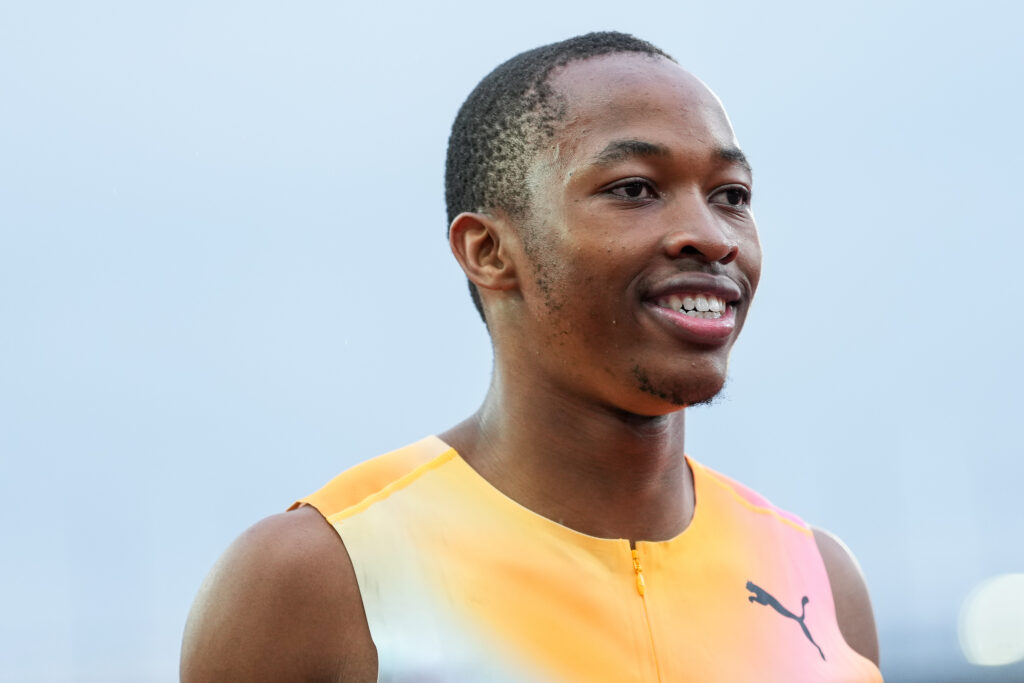
When we originally documented the tectonic shift in South African sprinting on July 19 this year, the mood across the nation was already one of historic celebration. Five South African men under ten seconds in a single calendar year; a golden age anchored by the ageless titan Akani Simbine and fuelled by an uncompromising youth vanguard. We noted then that 20-year-old Bayanda Walaza was already a rare breed, sitting on three career sub-10s before his prime had even officially knocked on the door.

We didn’t know it at the time, but the ink had barely dried on that chronicle before Walaza decided the conversation needed an immediate upgrade.

Just 48 hours later, on a brisk evening at Štadión SNP in Banská Bystrica, Slovakia, Walaza blasted out of the blocks and stopped the clock in a blistering 9.89 seconds. If July was about declaring that South Africa had rewritten the laws of speed, September has made something else unequivocally clear: Bayanda Walaza is no longer merely an apprentice in this sprint revolution. He is rapidly becoming its world-stage centrepiece.

Over the past week alone, Walaza turned an exceptional European tour into a masterclass of rare, historic consistency. On September 2 in Smederevo, Serbia, he unleashed another 9.89. Six days later, under the lights of Stadio Quercia in Rovereto, Italy, he clocked 9.91 last night.

Three runs in less than two months. All of them faster than 9.92. Six career sub-10 clocking’s in total, and he will not celebrate his 21st birthday until February next year.

To understand what Walaza is constructing, you have to look at the sheer chronology of South African sprinting.

South African Sprint Prodigies Walaza and Koekemoer Light Up Brescia with Double Gold
OSTRAVA, CZECH REPUBLIC - JUNE 16: Bayanda Walaza from South Africa celebrates winning the 100m Men competition during the 65th Ostrava Golden Spike, part of the World Athletics Continental Tour Gold 2026 at Mestsky Stadium on June 16, 2026 in Ostrava, Czech Republic. (Photo by Sona Maleterova/Getty Images)

The Boy Who Broke the Timeline

For over a century, breaking 10.00 seconds was a mythical, forbidden threshold on the southern tip of Africa. It took until 2014 for Simon Magakwe to crack the code at age 27. When Simbine and Henricho Bruintjies joined the fraternity in 2015, they were 21 and 22 respectively. Only two sprinters in South African history have ever breached the barrier before turning 21. Walaza didn’t just join that microscopic fraternity, he redefined its boundaries by becoming the first South African ever to do it as a teenager, clocking 9.99 at Pilditch Stadium in Pretoria at just 19 years and 34 days old.

He followed that two months later with a freezing-cold, wind-resisting 9.94 in Zagreb. By the time he lowered it again in Ostrava this past June (9.94), it was evident that the Olympic silver medallist from Paris 2024 was maturing at warp speed.

Now, with six official sub-10 performances to his name, Walaza stands utterly alone in South African athletics lore. No compatriot has ever approached this level of repeated, world-class velocity at this age.

Date

Time (s)

Wind (m/s)

Venue

Age at Race

15 Mar 2025

9.99

+0.7

Pretoria (RSA)

19y 34d

24 May 2025

9.94

-0.3

Zagreb (CRO)

19y 104d

16 Jun 2026

9.94

0.0

Ostrava (CZE)

20y 127d

21 Jul 2026

9.89

+1.0

Banská Bystrica (SVK)

20y 162d

02 Sep 2026

9.89

+0.6

Smederevo (SRB)

20y 205d

08 Sep 2026

9.91

+0.5

Rovereto (ITA)

20y 211d

Yet, the true magnitude of what Walaza is achieving extends far beyond national pride. When you zoom out to the broader canvas of track and field history, the air becomes breathtakingly thin.

The Prodigy of Velocity: Bayanda Walaza and the Rewriting of World Sprinting Royalty
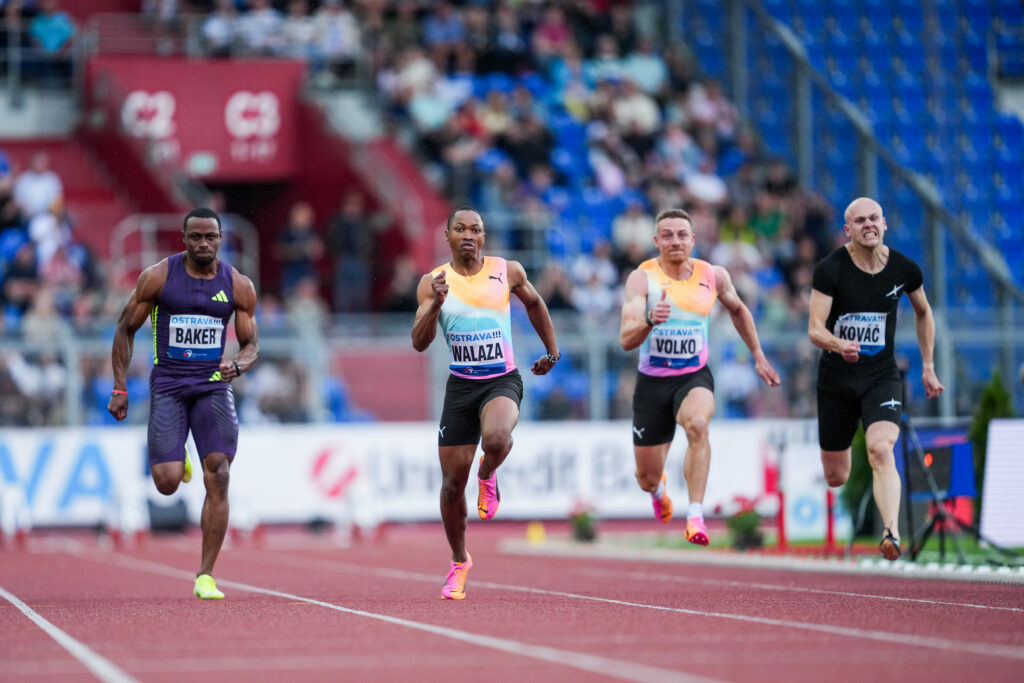
OSTRAVA, CZECH REPUBLIC - JUNE 16: (L-R) Ronnie Baker from United States, Bayanda Walaza from South Africa, Jan Volko from Slovakia and Dan Kovac from Czech Republic compete in the 100m Men competition during the 65th Ostrava Golden Spike, part of the World Athletics Continental Tour Gold 2026 at Mestsky Stadium on June 16, 2026 in Ostrava, Czech Republic. (Photo by Sona Maleterova/Getty Images)

The U21 Pantheon: A Quartet of Legends

Scouring the World Athletics archives back through a quarter-century of data reveals a stark reality: running under 10 seconds before your 21st birthday is not just rare; it is an almost mythical predictor of all-time greatness. Running it six or more times borders on the miraculous.

Since the turn of the millennium, only three men in global athletics had ever achieved that feat before turning 21:

  1. Trayvon Bromell (USA) – The benchmark of early-career explosiveness, who amassed an astonishing 10 sub-10s before age 21, including a world junior record and an individual World Championship bronze.
  2. Andre De Grasse (CAN) – The future Olympic champion and perennial championship podium lock, who breached the barrier 6 times as an emerging collegiate powerhouse.
  3. Letsile Tebogo (BOT) – The reigning Olympic 200m champion and African sprint phenom, who announced a new continental dawn with 6 sub-10 outings before leaving the junior ranks.

As of last night in Rovereto, that exclusive global trio has officially become a quartet

Walaza joins Bromell, De Grasse, and Tebogo as the only four men in the modern era to record six or more legal sub-10s while under 21 years of age. He is running stride-for-stride with the historical ghosts of Olympic champions and generational icons.

The Prodigy of Velocity: Bayanda Walaza and the Rewriting of World Sprinting Royalty
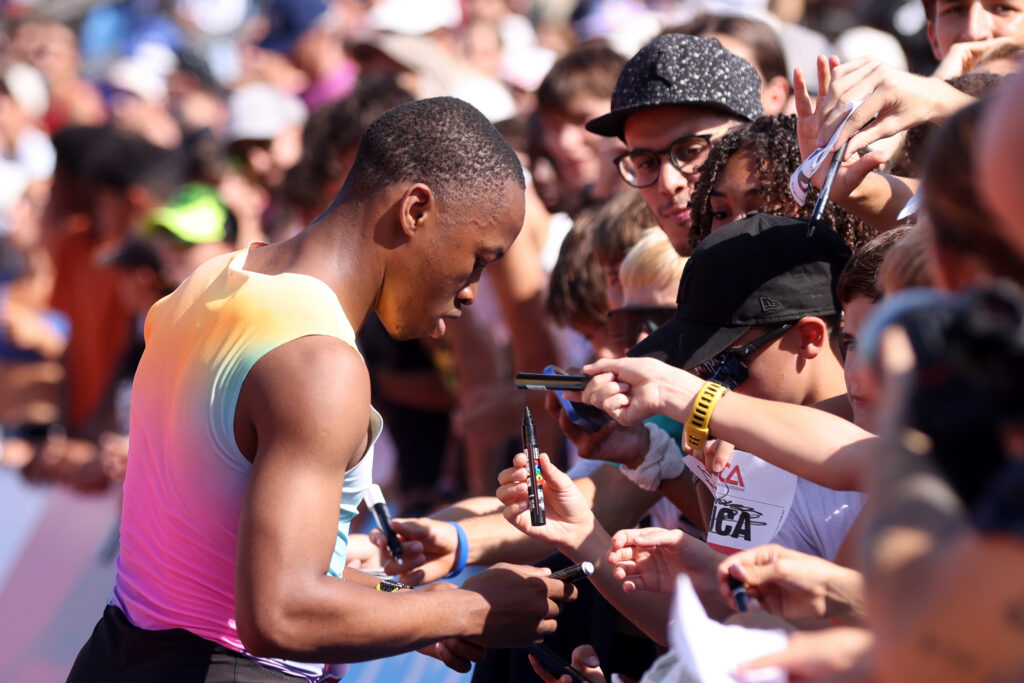
WALAZA Bayanda at the Grand Prix Brescia 2026 in Brescia, on August 30, 2026. (Photo by Stefano Nicoli/NurPhoto via Getty Images)

Beyond the Clock

What distinguishes Walaza in the blocks isn’t just physical wattage, it is the unnerving composure of his race pattern.

Watch his dual 9.89 performances in Banská Bystrica and Smederevo, and you do not see an athlete straining for an outcome. You see upright posture, relaxed shoulders, and an elastic turnover that looks identical whether he is running in the preliminary heats of an African championship or anchoring an Olympic final against the world’s best. There is no grimace at 60 meters; there is only acceleration.

When South Africa tallied 74 total sub-10 runs back in July, we remarked that Simbine owned 51 of them. Simbine’s legacy as the architectural pillar of modern South African sprint culture is set in stone. But the baton of global dominance requires an heir with both the appetite and the biological firepower to carry it onto the highest steps of championship podiums.

In our July chronicle, we called South Africa’s sudden burst of speed a culture of velocity.

In Bayanda Walaza, that culture has found its ultimate expression. He is no longer just chasing history. At 20 years old, history is struggling to keep up with him.

For More South African Sports News: Sport South Africa Home Page

For More South African Athletics News: Athletics

For the Original Article On our South African Sub 10 Sprinters:

How South African Sprinters Rewrote The Laws of Speed

The post The Prodigy of Velocity: Bayanda Walaza and the Rewriting of World Sprinting Royalty appeared first on South Africa Sports News and Blog Site | South Africa Sport.

Mali: le Timbuktu Institute analyse l'intégration de l'intelligence artificielle dans la guerre informationnelle

« Des algorithmes en guerre », c'est le nom de l'étude publiée ce mercredi 9 septembre 2026 par le Timbuktu Institute, un centre de recherches basé à Dakar et qui s'est intéressé à l'utilisation de l'intelligence artificielle générative dans le conflit malien. Les jihadistes du Jnim, liés à al-Qaïda, leurs alliés indépendantistes du FLA, les autorités maliennes de transition, leurs partenaires russes de l'Africa Corps, et tous leurs soutiens respectifs utilisent désormais l'intelligence artificielle dans leur communication ou dans leur propagande.

In brief

ALG : Ferhat sous surveillance, Konaté à l’affût (Lyès. L) L’inquiétude a rapidement gagné les rangs du Mouloudia d’Alger après … L’article ALG : Ferhat sous surveillance, Konaté à l’affût (Lyès. L) est apparu en premier sur Foot Afrique.

Superbug ‘ate away’ All Black’s spinal disc Tamaiti Williams is beginning to see light at the end of a brutal health battle, but the All Blacks prop remains without a return date after a superbug threatened his career. The post Superbug ‘ate away’ All Black’s spinal disc appeared first on SA Rugby magazine.

Rassie: Springboks won’t be affected by reduced fan support in US The Springbok coach also said the shared flight with the All Blacks had 'good vibes', and being welcomed by fans in Baltimore was special.